My basic rule
I don’t use AI to get out of knowing what I’m doing.
I use it because I know what I want the work to do, and AI can collapse a surprising amount of distance between the idea and something real enough to judge.
It can generate an image, draft a release, write thousands of lines of code, compare a pile of information, or help track down difficult-to-find public business information.
What it cannot do for me is decide which problem is worth solving, what the audience needs, whether the answer is accurate, whether the work feels right, or when the first plausible answer should be thrown away.
The useful skill is not getting AI to produce something. It is knowing what good looks like well enough to keep steering until the output actually serves the goal.
Creative development
AI makes more ideas practical before the budget gets a vote.
Generative imagery has changed the economics of concept development in a very real way.
For a WiTricity consumer campaign, I could explore highly specific scenes — a dinosaur making plug-in charging feel extinct, or a polished Florida lifestyle image built around the absence of charging hassle — without starting with locations, vehicles, talent, props, photographers, and a production budget large enough to scare the idea back into a stock-photo library.
The process still required concept development, copywriting, art direction, image selection, iteration, compositing, retouching, and Photoshop finishing. AI simply made the custom visual territory available much earlier.
The tool expanded the number of ideas I could seriously consider. It did not decide which ideas were worth making.



AI-assisted development
AI changed the size of the things I can build myself.
I have always been comfortable moving between design and code. AI dramatically widened that lane.
I use it as a development partner to accelerate PHP, JavaScript, SQL, integrations, debugging, refactoring, and the thousand small technical steps between “this would be useful” and “people are using it.”
That has allowed me to take on browser-based systems and functionality that would traditionally require much more development time and to move into technologies outside my everyday stack without treating unfamiliar syntax as a reason to stop.
But faster code generation does not remove the parts that require judgment. I still have to define the workflow, understand the data, design the experience, think through permissions and edge cases, test the behavior, recognize when the generated answer is wrong, and decide whether the thing is ready to deploy.
AI can write code very quickly. Knowing what the software should do is still the harder problem.
AI inside the work
Sometimes AI is not helping me build the tool. It becomes part of the tool.
In the WiTricity CRM, I integrated an AI advisor that can work across the structured information already in the system.
Instead of forcing leadership to manually compare dashboards, activity, contacts, opportunities, and individual records, the system can answer broader questions, surface patterns, and help make the data easier to interrogate.
That is the kind of AI integration I find most interesting: not a chatbot attached because somebody wanted an AI feature, but a practical layer that removes friction between having information and being able to use it.
The goal is not to replace the decision. It is to give the person making it a better view of what is already there.
Communication
Some ideas are easy to explain and hard to picture.
AI is especially useful when the communication depends on showing a scenario that does not conveniently exist in a photo library.
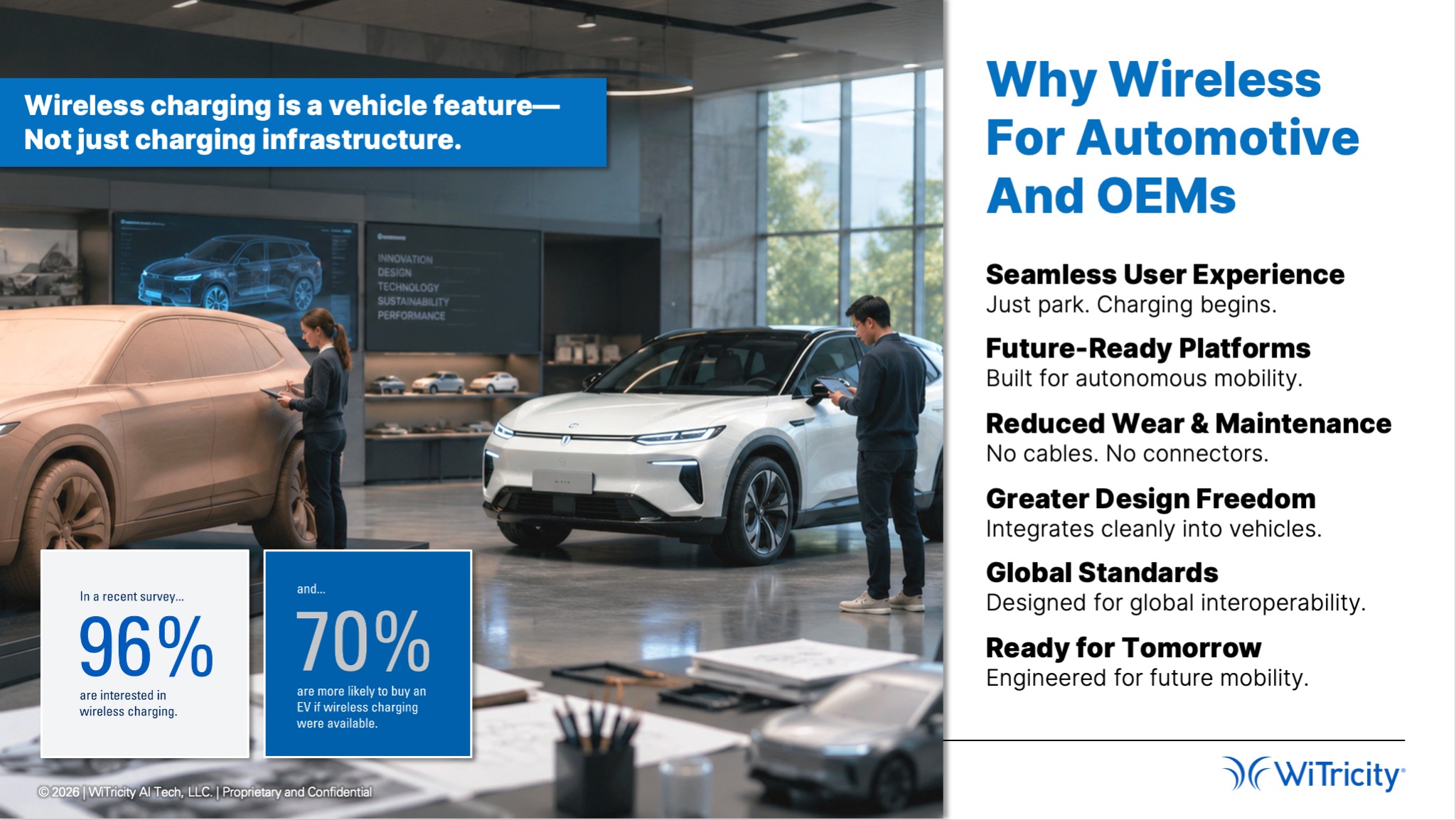
For sales and marketing presentations, I have used AI-assisted image development to visualize future-facing automotive and mobility scenarios, then combined those visuals with traditional design, copywriting, information hierarchy, and presentation strategy.
I also use AI much earlier in the communication process, to help digest technical material, explore ways to frame an argument, develop first drafts, compare language, and move from subject-matter input to something a real audience can understand.
The image may be generated. The communication problem still has to be solved.
The less glamorous part
A lot of the value is simply getting through Tuesday faster.
Not every useful AI application turns into something worth putting on a wall.
I use it to draft press releases, pressure-test headlines, organize rough notes, summarize long technical material, compare information across sources, analyze data, prepare for meetings, find difficult-to-locate public contacts, work through unfamiliar technical documentation, and get a useful first version on the screen sooner.
Most of that work still gets edited, verified, rewritten, challenged, or discarded before anybody else sees it.
That is fine. The point is not to preserve the AI output. The point is to preserve the time and attention I can spend on the parts of the job that benefit most from experience and judgment.
- Concept exploration
- Generative imagery
- Photoshop refinement
- Web & application development
- Debugging & technical problem-solving
- Research & synthesis
- Public contact discovery
- Draft writing & editing
- Data analysis
- Decision support
Where judgment matters most
The more AI can produce, the more valuable it becomes to know what not to use.
AI is fast. It is also perfectly capable of being confidently wrong, visually generic, technically fragile, badly written, or just boring.
So my responsibility has not become smaller. In some ways it has become more obvious.
- give the system enough context to understand the real assignment
- recognize when an answer is plausible but wrong
- verify factual claims, research, names, links, and technical behavior
- push creative output beyond the first obvious interpretation
- edit writing until it sounds specific, human, and appropriate to the audience
- test code and interfaces as working systems rather than trusting generated output
- know when a specialist, a human conversation, or a different tool is still the better answer
AI has made production cheaper and iteration faster. It has not made taste, experience, curiosity, or accountability optional.
What this capability really adds
It lets me stay closer to the work.
For most of my career, the limit on a good idea was often time, budget, or whether the next required skill belonged to somebody else.
AI changes that equation. I can explore more creative territory, build working systems faster, move across technical boundaries more confidently, and get to something testable while the problem is still fresh.
There are still plenty of reasons to use specialists. There are simply fewer reasons to stop at “I know what this should be” when I can keep going and make it.
The point is not that AI can do more of my job. Used well, it lets me do more of my job — without giving up the judgment that made the work worth doing in the first place.